
Professionals who hold the SAP Certified - Implementation Consultant - End-to-End Business Processes for SAP Business Suite (exam code C_IEE2E) typically earn between $85,000 and $150,000+ per year in the United States, with the broader SAP consultant market averaging around $99,860 according to PayScale and as high as $147,520 in Indeed's aggregated data. Because C_IEE2E validates cross-process implementation skill rather than a single narrow module, certified consultants often sit at the higher end of that band once they have two or three years of project experience.
This guide leads with the numbers — salary by region, experience level, and role — then walks through the exam cost, what the certification actually proves, and whether the return on investment justifies the roughly $578 exam fee and study time. If you are weighing this credential against a specialized module certification, the salary math below will help you decide.
How Much Does an SAP C_IEE2E Consultant Earn?
An SAP end-to-end business processes consultant in the United States earns an average base salary in the $85,000 to $120,000 range, with total compensation reaching $150,000 or more at senior levels. The exact figure depends on experience, region, industry, and whether you work in-house or for a consulting firm.
There is no salary survey that isolates the C_IEE2E credential by name, because it is a relatively new certification aligned to the SAP Business Suite. So the most reliable approach is to look at the wider "SAP consultant" and "SAP implementation consultant" market and then adjust for the cross-process nature of this role. Two independent data sets give us a defensible range:
-
PayScale reports an average base salary of $99,860 per year for SAP consultants in the US (data as of April 2026), with a 10th-to-90th-percentile spread of $65,000 to $157,000.
-
Indeed reports a higher average of $147,520 per year (about $71.00/hour, updated June 2026), drawn from more than 1,400 salary reports, with a range running from roughly $106,000 to $205,000.
The gap between the two averages is normal. PayScale skews toward self-reported base pay across all experience levels, while Indeed aggregates advertised and reported pay that often includes contract and senior roles. Read together, they bracket a realistic expectation: entry-level around $70K–$85K, mid-career around $100K–$130K, and senior/lead consultants comfortably above $150K.
"End-to-end process consultants are valued precisely because they connect finance, procurement, manufacturing, and sales into one working system. That breadth is harder to hire for than a single-module specialist, and the market pays for it." — paraphrased from the consensus view expressed by SAP implementation practitioners in the ASUG (Americas' SAP Users' Group) community.
If you want to see how process-focused roles compare with narrower technical modules, it helps to weigh a cross-process consultant's pay against the salaries commanded by SAP's highest-earning technical specializations.
What Salary Can You Expect by Experience Level?
Experience is the single biggest driver of SAP consultant pay, and the curve is steep. PayScale's data shows clear jumps at each stage of a career.
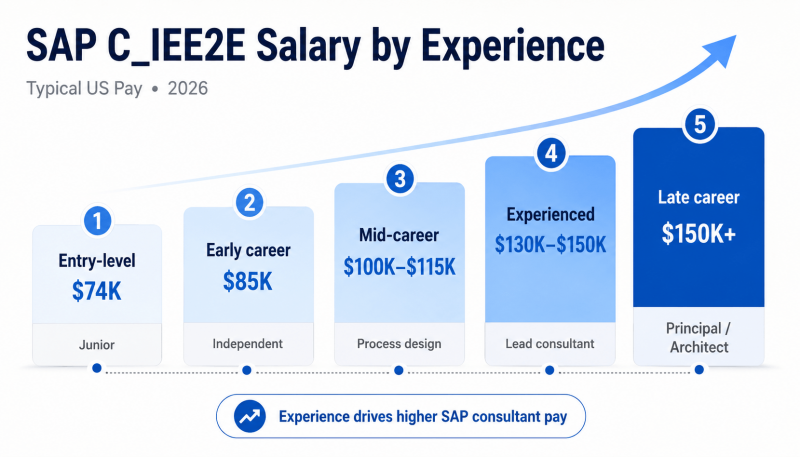
| Entry-level (<1 year) | ~$74,000 | Junior/associate consultant, supervised delivery |
| Early career (1–4 years) | ~$85,000 | First independent process workstreams |
| Mid-career (5–9 years) | ~$100,000–$115,000 | Owns end-to-end process design |
| Experienced (10–19 years) | ~$130,000–$150,000 | Lead consultant / solution owner |
| Late career (20+ years) | ~$150,000+ | Principal, architect, or practice lead |
Source: derived from experience-band figures reported by PayScale (April 2026). PayScale notes that experienced consultants earn roughly 42% more than mid-career peers, and late-career professionals command about a 22% premium over the mid-career baseline.
The reason C_IEE2E holders tend to move up this curve quickly is that the credential is built around integrated processes — Record-to-Report, Source-to-Pay, Lead-to-Cash, and Design-to-Operate. Employers reward the ability to design and troubleshoot a full process chain, not just configure one screen. That is also why ERPPrep's guide to certification's effect on career growth stresses breadth as a promotion accelerator.
Does SAP C_IEE2E Pay Differ by Region?
Yes — location changes SAP consultant pay dramatically, both within the US and globally. Metro areas with dense enterprise-software demand pay a clear premium.
Within the United States, Indeed identifies Chicago, IL as a top-paying market (around $118/hour for contract SAP consultants), followed by Bay Area hubs such as Sunnyvale, CA and financial centers like Jersey City, NJ. As a rough guide:
-
High-cost tech and finance metros (San Francisco Bay Area, New York/New Jersey, Chicago, Seattle) — expect a 15%–30% premium over the national average.
-
Mid-tier metros (Dallas, Atlanta, Denver, Charlotte) — roughly at or slightly above the national average.
-
Lower-cost regions and remote roles — often near or slightly below average, though remote work has compressed this gap.
Internationally, SAP consulting pay varies widely by market maturity and currency. Western Europe (Germany, Switzerland, the UK) and the Gulf states tend to pay strong packages, while India and Southeast Asia offer lower nominal salaries but very high demand and fast progression. Because the C_IEE2E exam and the underlying SAP Business Suite are global, the credential travels well across borders — a meaningful advantage if you plan to work internationally. For a market-demand view, ERPPrep also covers why ERP modules in SAP are in huge demand.
Salaries vary by region, employer, and experience, and aggregator figures change monthly. Always treat the numbers here as ranges retrieved in mid-2026, not fixed guarantees.
Which Job Roles Use the C_IEE2E Certification?
The C_IEE2E credential maps to roles that span multiple SAP processes rather than a single module, which broadens the job titles you can target. Common roles include:
-
SAP Implementation Consultant — configures and deploys end-to-end business processes on client projects.
-
SAP Business Process Consultant / Analyst — translates business requirements into integrated SAP process designs.
-
SAP Functional Consultant (cross-module) — supports finance, procurement, sales, and manufacturing flows together.
-
SAP Solution / Application Consultant — owns solution design across the SAP Business Suite.
-
SAP Support / AMS Consultant — troubleshoots live process chains in production environments.
Because these roles require someone who understands how one process feeds another, they are often paid above single-module specialists at the same experience level. If a consulting career is your goal, ERPPrep's guide to the SAP consultant career path lays out the route from certification to billable delivery.
How Is the C_IEE2E Exam Structured?
The C_IEE2E exam is a modern, system-based assessment. Here are the confirmed logistics.
| Exam code | C_IEE2E |
| Full name | SAP Certified - Implementation Consultant - End-to-End Business Processes for SAP Business Suite |
| Certification level | Associate |
| Format | System-based Assessment (SyBA) — scenario/performance-based |
| Duration | 120 minutes |
| Passing (cut) score | 64% |
| Exam fee | ~$578 USD (varies by country/currency) |
| Validity | 12 months (mandatory yearly renewals) — renew by passing the current assessment |
| Registration | SAP Learning certification portal (SAP Universal ID) |
Sources: SAP's official certification page for the duration, cut score, format, and level; the ERPPrep C_IEE2E syllabus for fee and validity. Question counts and fees change between exam versions, so confirm the live figures before you register.
The 12-month validity with mandatory yearly renewal is important for your ROI calculation: this is not a one-and-done credential. SAP now keeps associate certifications current through annual assessments, so budget for ongoing renewal effort. You register through the SAP Learning certification portal using your SAP Universal ID at learning.sap.com, and exams are delivered via Pearson VUE.
What Does the SAP Learning Journey for C_IEE2E Look Like?
SAP structures preparation for C_IEE2E around a single guided learning journey. The SAP Learning Journeys portal walks you through each process area — financial and management accounting, procurement and warehouse logic, production, sales, service, and workforce integration — in a connected order, then reinforces it with hands-on system exercises before you sit the assessment. Because the exam is system-based, the journey emphasizes practising in the environment, not memorizing facts.
What does SAP's C_IEE2E learning journey actually cover?
Unlike most SAP tracks, which string together a sequence of modular courses, SAP's official preparation path for this credential is built as one continuous course — Exploring End-to-End Business Processes in SAP Business Suite — running roughly 32.7 hours (about 1,962 minutes) of guided content. That single-course design is deliberate: SAP treats end-to-end process knowledge as one connected body of work rather than a set of isolated modules, which mirrors how the exam itself chains processes together instead of testing them one at a time. Plan for that block of study time as a single sustained effort, not a checklist of separate courses to tick off.
A structured plan pairs well with a layered practice approach:
-
Micro Skill Drill — short, focused exercises that isolate one process step at a time so each competency becomes automatic.
-
Unified Scenario — end-to-end, multi-part cases that mirror how the real assessment chains processes together across finance, procurement, production, and sales.
-
Consultant Thinking Path — working through the "why" behind each decision the way a practising consultant reasons on a live project.
-
Tiered Validation Guidance — checking readiness in stages, from single-step accuracy up to full-scenario execution, so gaps surface before exam day.
Is the SAP C_IEE2E Certification Worth It?
For most implementation and business-process consultants, the C_IEE2E certification is worth it — the salary uplift and role flexibility usually outweigh the roughly $578 exam fee and study time within the first year of certified work. The value comes from three things: breadth, market demand, and credibility.
Breadth pays. A single-module certification proves you can configure one area. C_IEE2E proves you understand how finance, procurement, manufacturing, and sales connect — the exact skill that makes someone billable on a full implementation. That breadth is a promotion lever, as ERPPrep's analysis of whether the credential justifies its cost explains in detail.
Demand is strong and durable. SAP runs mission-critical processes at a large share of the world's biggest companies, and end-to-end process expertise is consistently listed among the hardest ERP skills to hire. Broader IT consulting demand is healthy too — U.S. Bureau of Labor Statistics data for computer systems analysts, a closely related occupation, projects steady above-average employment growth this decade, and enterprise-software roles track that trend.
Credibility is verifiable. Employers and clients can confirm your credential through your SAP digital badge on Credly, which removes doubt during hiring and rate negotiation.
A simple ROI snapshot
| Exam fee | ~$578 |
| Study time | 6–10 weeks part-time |
| Typical first-year salary lift after certification + a project | $5,000–$15,000+ |
| Payback period | Often under one year |
Even at the conservative end, a mid-single-digit-thousand salary lift covers the exam fee many times over. The main cost is time — and structured practice shortens that considerably.
Who Should Take the C_IEE2E Exam?
This certification fits several candidate profiles:
-
Existing SAP consultants who want to prove cross-process capability and move from a single module into full implementation work.
-
Career changers from finance, supply chain, or operations who already understand business processes and want to formalize SAP skills.
-
Recent graduates aiming for a consulting entry point — pair it with ERPPrep's guide on getting certified early in your career.
-
Functional analysts who support SAP day to day and want a credential that reflects the full process picture.
It is less ideal if you want to go deep on one specialized area first — in that case a focused module certification (for example, a finance or procurement credential from the SAP S/4HANA certification hub) may be a better first step, with C_IEE2E added later.
How Do You Prepare for the C_IEE2E Exam?
Preparation should mirror the exam's scenario-based format — you cannot memorize your way through a system-based assessment. A practical study plan looks like this:
- Map the process chains. Learn Record-to-Report, Source-to-Pay, Lead-to-Cash, and Design-to-Operate as connected flows, not isolated modules. SAP's structured learning journeys are the primary free study path.
- Practice in the system. Because the assessment tests system behavior, hands-on exposure matters more than reading. Work through configuration and transaction steps where you can.
- Drill with realistic scenarios. Use scenario-style questions to build the decision-making pattern the exam rewards. ERPPrep's guide to building an SAP certification study plan covers time management and question strategy.
- Simulate exam conditions. Take timed mock assessments to get comfortable with the 180-minute, constraint-based format.
For a deeper background on what SAP process integration means in practice, the SAP Business Suite context on Wikipedia's ERP overview is a useful primer before you dive into the technical detail.
Ready to Pass on Your First Attempt?
The salary data all points to one thing: consultants who can connect finance, procurement, manufacturing, and sales into a single working process are scarce, and that scarcity is exactly what employers pay a premium for. Building that cross-module fluency takes deliberate, scenario-based practice — the kind that mirrors how the System-based Assessment actually chains processes together, not isolated fact recall. Start by mapping the four end-to-end flows, rehearse them until the connections feel automatic, and let the certification put a verifiable stamp on skills the market is already short of.
Frequently Asked Questions
How much does an SAP C_IEE2E consultant earn per year?
In the US, expect roughly $85,000 to $150,000+ depending on experience. The broader SAP consultant average is about $99,860 per year per PayScale and up to $147,520 per Indeed as of mid-2026.
Is the SAP C_IEE2E certification worth it?
For most implementation and process consultants, yes. The ~$578 exam fee is typically recovered within a year through higher pay and broader role eligibility, and the cross-process skill it validates is in strong demand.
How much does the C_IEE2E exam cost?
The exam fee is approximately $578 USD, though the exact price varies by country and currency. Confirm the current fee when you register through your SAP Universal ID.
What is the passing score for C_IEE2E?
The cut score is 64%, based on the ERPPrep C_IEE2E syllabus. Cut scores can be adjusted between exam versions, so verify on the official SAP page before your attempt.
How long is the C_IEE2E exam?
The exam runs 180 minutes and is delivered as a System-based Assessment (SyBA), meaning scenario-driven, performance-based tasks.
How long is the C_IEE2E certification valid?
Twelve months. SAP requires yearly renewal, which you complete by passing the current version of the assessment. Budget for this ongoing renewal when planning your certification path.
Do I need experience before taking C_IEE2E?
It is an associate-level exam, so formal experience is not mandatory, but hands-on exposure to SAP processes makes a big difference because the assessment tests system behavior, not memorized facts.
Which pays more: C_IEE2E or a single-module SAP certification?
It depends on the market, but cross-process consultants often earn more than single-module specialists at the same experience level because they can lead full implementations. Compare options using ERPPrep's guide to the highest-paid SAP modules.
Where can I take the exam?
Online proctored or at a physical Pearson VUE test center. Register with your SAP Universal ID at learning.sap.com.
How do I prove I hold the certification to employers?
SAP issues a verifiable digital badge through Credly, which employers and clients can check directly.
Disclaimer: This content is for exam preparation and educational purposes only. Always refer to official SAP training resources (learning.sap.com) for the most current exam objectives and requirements. Salary figures are aggregated ranges retrieved in mid-2026 and vary by region, employer, and experience.















 English (US) ·