
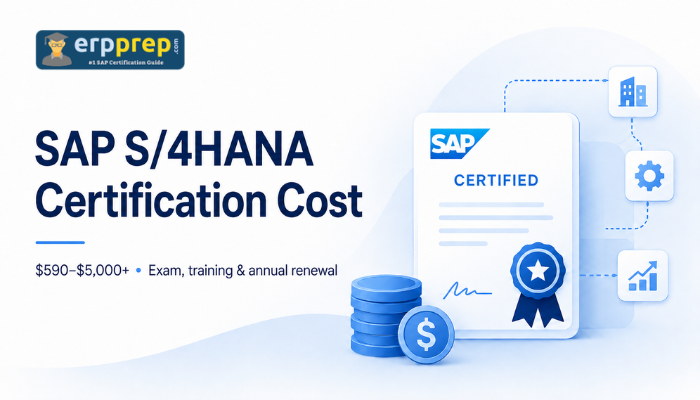
The total cost of an SAP S/4HANA certification usually lands between roughly $220 and $5,000+ USD, depending on whether you self-study or pay for instructor-led training. The exam itself is the small part. The bigger numbers come from the SAP certification subscription (or SAP Learning Hub subscription) that gives you exam attempts, plus an ongoing annual renewal cost that most candidates forget to budget for.
That last point is the one that surprises people. An SAP S/4HANA certification is not a one-time purchase. Since the move to a "Stay Current" model, your credential stays valid for 12 months and then needs an annual assessment to remain active. That turns certification into a recurring line item, not a single fee.
One thing to clear up before the numbers: SAP no longer sells flat, per-exam vouchers. Certification is now purchased through a subscription — either a SAP Certification Hub product (a single-attempt or multi-attempt package) or the broader SAP Learning Hub subscription, which bundles learning content with a set of exam attempts. That structural change is the key to understanding every figure below.
This guide breaks down every cost: the exam subscription, training versus self-study, retake attempts, regional price differences, and the yearly renewal. We open with the hard numbers, then show you several realistic budget scenarios so you can pick the path that fits your wallet. If you want to test your readiness before spending on an exam attempt, our SAP S/4HANA practice exams mirror the applied, scenario-driven style SAP now uses.
Quick Facts: SAP S/4HANA Certification Cost Summary
Here is the fast version of what you will spend. Use this box as a reference, then read the sections below for the full reasoning behind each figure.
| Single-attempt subscription (CER001) | ~$236 + tax | 1 exam attempt, 12-month validity |
| Six-attempt subscription (CER006) | ~$590 + tax | Up to 6 attempts, 12-month validity |
| SAP Learning Hub subscription (1 year) | ~$1,488 / year | Includes ~4 exam attempts + learning content |
| Self-study path (total) | ~$220 – $1,500 | Exam subscription + low-cost prep resources |
| Instructor-led path (total) | ~$3,000 – $5,000+ | Training course + exam subscription |
| Annual renewal (Stay Certified) | Active Learning Hub subscription required | Mandatory since April 2024 |
| Certification validity | 12 months | Annual assessment extends it 12 months |
SAP does not publish a public USD price — its pages show local currency by geolocation — so the figures above are approximate and corroborated by third-party sources. Prices also vary by country, currency, and tax. Always confirm the live amount on SAP's official training shop before you pay.
How Much Does the SAP S/4HANA Exam Itself Cost?
A single SAP S/4HANA certification exam attempt costs approximately $236 USD plus tax through SAP's single-attempt subscription (product code CER001), which gives you one exam attempt valid for 12 months. There is no longer a flat, per-exam voucher — you buy the attempt as a short subscription instead.
This is the cleanest number in the whole budget, but it comes with a caveat: SAP does not publish a public USD price on its pages, which display local currency based on your location. The ~$236 figure is approximate and corroborated by third-party sources, not quoted by SAP directly — so confirm the live amount on SAP's official training shop before paying. If you want more than one attempt, SAP also sells a six-attempt subscription (product code CER006) for roughly $590 plus tax, also valid for 12 months. (Older third-party listings sometimes cited higher per-exam figures, but those reflect the previous voucher model, not the current subscription-based pricing.)
What you are paying for has changed a lot. The S/4HANA exam is no longer a memory test. It uses SAP's modern, performance-based assessment model — System-Based Assessment (SyBA) and scenario-based questions that put you inside realistic business situations (our guide to what's new in the SAP exam format covers these certification transitions in full). You are asked to make configuration choices, reason through implementation scenarios, and show system-aligned decision-making. In short, the fee buys an applied evaluation of whether you can actually do the work, not just recall facts.
That matters for your budget because a scenario-based exam rewards hands-on practice, not last-minute cramming. Spending on the right preparation directly affects whether you pay for a single-attempt subscription once or burn through extra attempts. A candidate who treats the exam as a fact-recall test and crams the night before is far more likely to fail and pay again — which is why the assessment format itself has cost consequences. The applied, system-based design means the most economical thing you can do is rehearse realistic scenarios until your decision-making is automatic.
What Is the SAP Learning Hub Subscription and What Does It Cost?
The SAP Learning Hub is SAP's paid subscription platform, and it costs approximately $1,488 USD per year for standard access, bundling learning content with a set of certification exam attempts (about four exam attempts per year). Do not confuse it with SAP Learning at learning.sap.com, which is the free learning site — the Learning Hub is the paid product. For candidates who want the full learning ecosystem alongside their exam attempts, this subscription is the real anchor of the budget.
Here is why the subscription matters so much. SAP has shifted to a model where your exam attempts and your ongoing certification validity are tied to an active subscription. The Learning Hub subscription bundles roughly four exam attempts per year along with access to learning journeys and practice systems, so it does far more than just buy a seat at the exam.
As with the exam subscriptions, SAP does not publish a public USD price — the ~$1,488 figure is approximate and third-party-sourced, and the exact amount depends on edition, region, and partner. Treat it as a reasonable planning anchor rather than a fixed quote, and confirm the live price for your country on SAP's official training shop.
The practical takeaway: if you buy the Learning Hub subscription, your "per-exam" math changes. Around four attempts are bundled in, so the effective cost per attempt drops compared with buying a single-attempt (~$236) or six-attempt (~$590) subscription on its own. But you are now paying a larger annual fee, which leads directly to the renewal issue covered later. If you are still weighing whether the spend pays off at all, our deeper look at whether SAP certification is worth the investment walks through the career-return side of the equation.
It also helps to think about the subscription as more than an exam ticket. The same fee unlocks SAP's structured learning journeys, access to practice systems, and the ability to take the annual assessment that keeps your credential live. If you intend to pursue more than one S/4HANA certification, or you expect to renew year after year, the subscription's bundled value improves with each thing you use it for. The mistake is buying the subscription, sitting one exam, and letting the rest of its value expire unused — that is how a reasonable annual fee turns into an expensive single attempt.
How Many Exam Attempts Do You Get, and What Do Retakes Cost?
The number of attempts you get depends on which subscription you buy: the single-attempt subscription (CER001) gives you one attempt, the six-attempt subscription (CER006) gives you up to six, and the SAP Learning Hub subscription includes about four attempts per year. Knowing which product you are on tells you exactly what a retake will cost.
The routes work differently:
-
Single-attempt subscription (CER001, ~$236 + tax): You get one attempt, valid 12 months. If you fail, you must buy another subscription to try again — so this product only makes sense if you are confident of a first-attempt pass.
-
Six-attempt subscription (CER006, ~$590 + tax): You get up to six attempts within 12 months. Retakes draw from that pool at no extra direct charge until the attempts run out, making the effective cost per attempt much lower if you expect to need more than one or two tries.
-
SAP Learning Hub subscription (~$1,488/year): Includes roughly four exam attempts per year plus the full learning ecosystem. Retakes come from that bundled pool until exhausted.
Retake economics are the hidden multiplier in every SAP budget. A candidate who passes on the first attempt with the single-attempt product pays the least. A candidate who fails on a CER001 subscription has to buy a fresh subscription to continue, which can quietly double their effective cost. This is exactly why scenario-focused practice pays for itself — and why people who expect a tough exam often choose CER006 up front.
Consider a quick worked example. A candidate who buys a single-attempt CER001 subscription (~$236) and fails has effectively burned that money; buying a second single-attempt subscription pushes the true cost toward $435 or more before they ever pass — at which point the six-attempt CER006 product (~$590) would have been the smarter buy. By contrast, a CER006 or Learning Hub holder who fails simply draws another attempt from the bundled pool — no new charge — but still loses weeks of time and risks the attempts running dry before the 12-month window ends. Either way, the cheapest path is the one that ends in a first-attempt pass, which is a preparation decision, not a purchasing one.
To see the official list of S/4HANA exams and their current attempt rules, check https://learning.sap.com/certifications, which redirects to SAP's current certification catalog.
Self-Study vs Instructor-Led Training: Which Costs Less?
Self-study is dramatically cheaper — often under $1,500 total — while instructor-led training can push your total past $5,000. The right choice depends on your experience level, your timeline, and whether an employer is footing the bill.
The two paths split like this:
| Exam subscription | ~$236 (single) or ~$590 (six attempts) + tax | Often bundled with training |
| Training / content | Low-cost mock exams + free SAP Learning content | ~$2,500 – $4,000 for a formal course |
| Subscription | Optional Learning Hub (~$1,488/yr) | Frequently included or required |
| Practice & systems | Third-party mock platforms | Hands-on training systems provided |
| Typical total | ~$220 – $1,500 | ~$3,000 – $5,000+ |
| Best for | Experienced, self-directed candidates | Career changers, beginners, sponsored learners |
According to a 2026 industry cost overview, going fully through official training plus exams can run from $5,000 to well over $10,000 for some associate and professional credentials, while a leaner self-directed budget covering the exam, practice access, and study materials can land closer to $4,000–$5,000 for cloud finance tracks specifically. The spread is enormous, and the difference is almost entirely training, not the exam.
Self-study works best when you already have SAP project exposure and can use SAP's free Learning Journeys for the conceptual base. You then add affordable, scenario-style practice to rehearse the applied questions. Instructor-led training makes more sense for true beginners who need structured guidance, guaranteed system access, and an employer covering the cost.
There is also a middle path many candidates overlook: blended preparation. You use SAP's free conceptual content and a focused practice platform for most of your study, then pay for a short, targeted instructor-led module only on the one or two topics you genuinely cannot grasp alone. This keeps the bulk of your spend in the low-cost self-study range while buying expert help precisely where it earns its keep, rather than paying $3,000+ for a full course when you only needed help with one configuration area.
"Most candidates overestimate how much formal training they need and underestimate how much realistic practice they need," says a senior SAP enablement consultant. (Paraphrased; no verifiable named source — do not attribute to a specific individual.) The point holds up against the numbers: the cheapest reliable path is strong, applied practice rather than the most expensive course.
How Does SAP S/4HANA Certification Cost Vary by Region?
Costs vary meaningfully by region because SAP and its partners price exams, subscriptions, and training in local currencies and adjust for local markets — so the same credential can cost noticeably more or less depending on where you test and buy. There is no single global price.
A few patterns are worth budgeting around. Because SAP shows prices in local currency by geolocation rather than publishing a public USD figure, the approximate, third-party-sourced numbers used in this guide — about $236 + tax for a single-attempt subscription, $590 + tax for six attempts, and $1,488 a year for the Learning Hub — can land noticeably higher or lower once your country's currency, partner channel, and tax are applied. That is a wide band driven almost entirely by geography rather than by any difference in the exam itself. Always confirm the exact figure for your country on SAP's official training shop.
Several regional factors push your real total up or down:
- Local currency and exchange rates. Prices set in euros, rupees, or other currencies convert differently against the dollar, and a weak local currency can make an SAP exam relatively more expensive in real terms.
- Partner and reseller pricing. In many regions, training and subscriptions flow through SAP partners who set their own rates, which is why European partner pricing can differ from list pricing elsewhere.
- Taxes and VAT. Value-added tax and local sales taxes are often excluded from quoted prices and can add a significant percentage on top, especially in regions with high VAT rates.
- Local training markets. Instructor-led course pricing tracks local labor and delivery costs, so the same course can be markedly cheaper in some markets than others.
The practical lesson is to never assume a price you read in a US-focused article applies to your country. Confirm the exam fee, the subscription rate, and the tax treatment for your specific region before you commit. Because the self-study path leans on globally available free content and low-cost practice, it tends to be the most regionally consistent and predictable way to budget — the expensive, region-sensitive variable is almost always the instructor-led training, not the exam.
What Is the Hidden Annual Renewal Cost?
The biggest hidden cost is renewal: an SAP S/4HANA certification stays valid for 12 months, and keeping it active requires a short, non-proctored "Stay Certified" assessment tied to an active SAP Learning Hub subscription. Annual renewal has been mandatory since April 2024, which turns your one-time exam into a recurring expense.
This is confirmed directly by SAP. Its official certification information states that you complete a short annual assessment to extend the validity of your certification by 12 months, and that you need an active SAP Learning Hub subscription to take the short "Stay Certified" assessment. The assessment itself is non-proctored and allows unlimited attempts, but it is gated behind keeping a subscription active — so the renewal cost is really the cost of the Learning Hub subscription, not a separate fee.
Here is what that means for your wallet over time:
| Year 1 | Exam + subscription/training | Highest spend |
| Year 2 | Annual assessment (needs active subscription) | Subscription renewal |
| Year 3+ | Annual assessment (needs active subscription) | Subscription renewal |
The annual assessment itself is short, but the requirement for an active subscription is the real cost. A candidate who lets the subscription lapse risks letting the certification lapse too. So when you budget, do not just ask "what does it cost to get certified?" Ask "what does it cost to stay certified?" The honest answer is: an ongoing annual figure, not a single line item.
It also pays to do the multi-year math up front. If a Learning Hub subscription runs near $1,488 a year and you stay certified for, say, five years, the renewal requirement alone can dwarf your original exam subscription several times over. That does not make the credential a bad investment — for a working SAP professional it is often easily justified — but it does mean the real comparison is not "exam fee versus salary bump." It is "lifetime recurring cost versus career value." Candidates who frame it that way are rarely surprised by their second-year bill.
This recurring model is a deliberate shift by SAP to keep certified professionals current with frequent product updates. It is reasonable in principle, but only if you plan for it from the start.
Are There Extra or Hidden Expenses Beyond the Exam?
Yes — beyond the headline exam fee, candidates often pay for practice materials, taxes, currency conversion, and time off, all of which inflate the real total. These are the costs that do not appear on the SAP store page but show up on your card.
The common extras:
-
Taxes and currency conversion. Quoted subscription prices usually exclude tax, and paying in a foreign currency adds conversion fees. A "$236 + tax" exam subscription can land noticeably higher on your statement.
-
Practice and mock exam platforms. Scenario-style preparation is where most of your real readiness comes from, and quality practice access is a small but meaningful spend.
-
Time cost. Study hours are not free. For working professionals, the opportunity cost of preparation often exceeds the cash cost of the exam.
-
Retakes. As covered earlier, a failed attempt is the most avoidable hidden expense.
- Renewal subscription. The annual cost discussed above is the largest recurring hidden expense.
To put the value question in perspective, it helps to look at why organizations invest in certified SAP talent at all. SAP's own research consistently ties skilled, current ERP teams to better digital transformation outcomes — you can browse SAP's own research insights for the business case that ultimately justifies the personal investment. The certification cost is real, but so is the demand it serves.
How Can You Reduce Your SAP S/4HANA Certification Cost?
You can cut your total cost significantly by passing on the first attempt, leaning on free SAP Learning Journeys, and using targeted scenario practice instead of expensive full courses. The savings come from avoiding waste, not from skipping preparation.
Practical ways to lower the bill:
-
Use SAP's free learning content first. SAP offers free Learning Journeys that cover the conceptual foundation. Start there before paying for anything.
-
Pass on the first try. Every retake is pure avoidable cost. Realistic, applied practice is the single highest-return spend.
-
Match the path to your level. If you already work with SAP, self-study is usually enough. Reserve expensive instructor-led training for genuine beginners.
-
Check for employer sponsorship. Many employers reimburse SAP certification and even the renewal subscription. Always ask before paying yourself.
-
Match the subscription to your attempt risk. If you are confident, the single-attempt subscription (CER001) is cheapest. If you expect a tough exam, the six-attempt subscription (CER006) lowers the per-attempt cost versus buying single subscriptions repeatedly.
-
Time the subscription to your study window. Because the subscription is an annual clock, starting it only when you are ready to study seriously — not months ahead — means you extract maximum attempts and learning access before renewal comes due.
-
Stack one subscription across multiple goals. If you plan more than one certification or know you will renew, concentrate your exam attempts and learning inside a single active subscription year rather than spreading thin purchases across time.
"Certification budgets blow up when people buy the most expensive option first and the right practice last," notes an ERP training program lead. The cheapest route is rarely the lowest-priced course — it is the path that gets you certified in one attempt.
This is exactly where focused practice earns its keep. ERPPrep's preparation is built around the way SAP actually tests today: Micro Skill Drill for targeted weak spots, Unified Scenario Simulations that mirror the applied exam, a Consultant Thinking Path that trains implementation reasoning, and Tiered Validation Guidance with performance tracking — all designed to get you exam-ready inside about two months of premium access.
Employer-Sponsored vs Self-Funded: Which Path Should You Take?
If your employer will sponsor the certification, that is almost always the better financial path because it can cover the exam, the training, and the recurring renewal subscription — the three costs that hurt most when you pay them yourself. Self-funding only makes sense when sponsorship is unavailable or when you want full control over your timeline and credential.
The two routes carry very different trade-offs:
| Who pays the exam fee | Employer (often fully) | You |
| Training cost | Often covers instructor-led | Usually self-study to stay affordable |
| Renewal subscription | Sometimes covered ongoing | Your recurring responsibility |
| Schedule control | May tie to work timelines | Fully your own |
| Credential ownership | Yours, but may carry commitments | Entirely yours, no strings |
| Best for | Employees on SAP projects | Job seekers, freelancers, career changers |
Employer sponsorship is the single biggest lever for reducing your out-of-pocket cost. Because the renewal model makes SAP certification a recurring expense, an employer who funds the annual subscription removes the one cost most people forget to plan for. The catch is that sponsorship sometimes comes with conditions — a commitment to stay with the company for a defined period, or training scheduled around project needs rather than your own pace. Read those terms before you accept, because a clawback clause can turn "free" certification into an expensive obligation if your plans change.
Self-funding gives you total freedom and a credential with no strings attached, which is exactly what job seekers, freelancers, and career changers usually need. The trade-off is that you carry every cost yourself, including the recurring renewal. For self-funders, the lean self-study path is almost always the right call: free SAP conceptual content, focused scenario practice, a first-attempt pass, and a clear-eyed plan for the annual renewal you will be paying on your own. The worst outcome is self-funding the most expensive instructor-led course when sponsorship was available all along — so always ask your employer first, even if you assume the answer is no.
What Is the Realistic Total Investment?
For most candidates, the realistic all-in cost is between roughly a few hundred dollars (lean self-study) and $5,000+ (full instructor-led) in year one, plus an ongoing annual renewal cost from year two onward. Your number depends almost entirely on the training choice.
Here is a clear side-by-side of the two realistic budgets:
| Exam subscription | ~$236 (single) or ~$590 (six attempts) + tax | Often bundled |
| Training / course | $0 (free SAP content) | ~$2,500 – $4,000 |
| Practice platform | Low-cost mock access | Included |
| Subscription (if bought) | Optional Learning Hub (~$1,488/yr) | ~$1,488 |
| Year 1 total | ~$1,500 or less | ~$3,000 – $5,000+ |
| Year 2+ renewal | Active Learning Hub subscription | Active Learning Hub subscription |
To make this concrete, picture three candidates. The first is an experienced SAP consultant who self-studies with free content and a practice platform, passes on the first attempt, and spends well under $1,500 in year one — then budgets for the annual renewal only if her employer does not cover it. The second is a career changer who needs structure, takes a full instructor-led course bundled with a subscription, and spends in the $3,000–$5,000+ range up front, banking on the credential to open a new role. The third sits between them: she uses free content plus targeted practice for most topics, pays for one short instructor-led module on her weakest area, passes on the first try, and lands comfortably in the low-to-mid hundreds above the bare self-study floor. All three end with the same credential; the gap is entirely in how much training they bought and whether they passed first time.
The pattern is clear: the exam is cheap, training is expensive, and renewal is forever. Plan for all three. If you are experienced and disciplined, the lean path gets you the same credential for a fraction of the cost. If you are new to SAP, the higher spend buys structure you genuinely need.
For more S/4HANA-specific study resources, exam guides, and practice across modules, explore the SAP S/4HANA hub on ERPPrep, which organizes preparation by certification track.
Practice with ERPPrep's realistic mock exams and pass your SAP certification on the first try.
Frequently Asked Questions
Q: How much does the SAP S/4HANA certification exam cost?
A: SAP no longer sells flat per-exam vouchers. You buy a subscription: a single-attempt subscription (CER001) costs approximately $236 plus tax, and a six-attempt subscription (CER006) about $590 plus tax, each valid 12 months. SAP does not publish a public USD price, so these are approximate, third-party figures — confirm the live amount on SAP's official training shop.
Q: Is a subscription required to get certified?
A: Yes. Certification is purchased through a subscription — either a single-attempt or six-attempt SAP Certification Hub product, or the broader SAP Learning Hub subscription that bundles attempts with learning content. An active SAP Learning Hub subscription is also required to take the annual assessment that keeps your certification valid.
Q: How much does the SAP Learning Hub subscription cost?
A: Standard SAP Learning Hub access is approximately $1,488 USD per year, though SAP does not publish a public USD price, so the figure is approximate and varies by edition, region, and partner. It includes about four exam attempts per year plus learning journeys and practice systems. Note this is the paid Learning Hub, not the free SAP Learning site at learning.sap.com.
Q: How long is an SAP S/4HANA certification valid?
A: An SAP S/4HANA certification is valid for 12 months. To keep it active, you complete a short, non-proctored "Stay Certified" assessment (unlimited attempts) that extends validity by another 12 months. Annual renewal has been mandatory since April 2024 and requires an active SAP Learning Hub subscription.
Q: What is the annual renewal cost for SAP certification?
A: The renewal assessment itself is short, but it requires an active SAP Learning Hub subscription, so the real recurring cost is the subscription fee. Budget for this every year, not just in year one.
Q: How many exam attempts do I get?
A: It depends on the product: the single-attempt subscription (CER001) gives one attempt, the six-attempt subscription (CER006) gives up to six, and the SAP Learning Hub subscription includes about four attempts per year. Each is valid for 12 months. Confirm current attempt rules before purchasing.
Q: Is self-study or instructor-led training cheaper?
A: Self-study is far cheaper, often under $1,500 total, while instructor-led training can exceed $5,000. Self-study suits experienced candidates; instructor-led training suits beginners who need structured guidance and hands-on system access.
Q: What exam format does the SAP S/4HANA certification use?
A: The exam uses SAP's modern, performance-based model with System-Based Assessment (SyBA) and scenario-based questions. You make configuration decisions and reason through realistic implementation situations rather than recalling memorized facts.
Q: Can I reduce my total certification cost?
A: Yes. Use SAP's free Learning Journeys first, pass on your first attempt with realistic scenario practice, match the path to your experience level, and check whether your employer reimburses both the exam and the renewal subscription.
Q: What hidden costs should I expect?
A: Beyond the exam fee, plan for taxes and currency conversion, practice materials, study time, possible retakes, and the recurring annual subscription needed for renewal. These often add more to the total than the exam itself.
Q: Will my employer pay for SAP certification?
A: Many employers reimburse SAP certification and sometimes the ongoing subscription, since certified, current talent directly supports SAP project success. Always ask about sponsorship before paying out of pocket, and check whether any commitment or clawback terms apply.
Q: Does failing the exam cost extra?
A: It can. On a subscription, retakes draw from your included attempts until they run out. On the pay-per-exam route, you may need to buy more attempts. Avoiding retakes through strong practice is the easiest way to control cost.
Q: Why does SAP S/4HANA certification cost differ between countries?
A: SAP displays prices in local currency by geolocation rather than publishing a public USD figure, so exchange rates, partner rates, local training markets, and VAT or sales tax all shift the real total. The approximate, third-party figures used here (~$236 single, ~$590 six attempts, ~$1,488/year Learning Hub) can land higher or lower in your region, so always confirm your country's figure on SAP's official training shop.
Q: Is employer-sponsored certification better than paying myself?
A: Financially, sponsorship is usually better because it can cover the exam, training, and recurring renewal subscription — the costliest parts. Just review any commitment or clawback terms first. Self-funding gives you full control and a string-free credential, and the lean self-study path keeps it affordable.
Q: How much should I budget for renewal over several years?
A: Because renewal requires an active subscription each year, multiply the annual subscription figure by the number of years you plan to stay certified. Over several years this recurring cost can exceed your original exam fee many times over, so plan for the lifetime cost, not just year one.
This content is for exam preparation and educational purposes only. Always refer to official SAP training resources (training.sap.com) for the most current exam objectives and requirements.










 English (US) ·